Teriviolon
11 minutesNo notes in this margin yet.
Soon you’ll be able to leave a note on any line, or stamp it:
chillscalled itre-read thisoh no
Life couldn’t be better, Alice thought, squinting up at the sky.
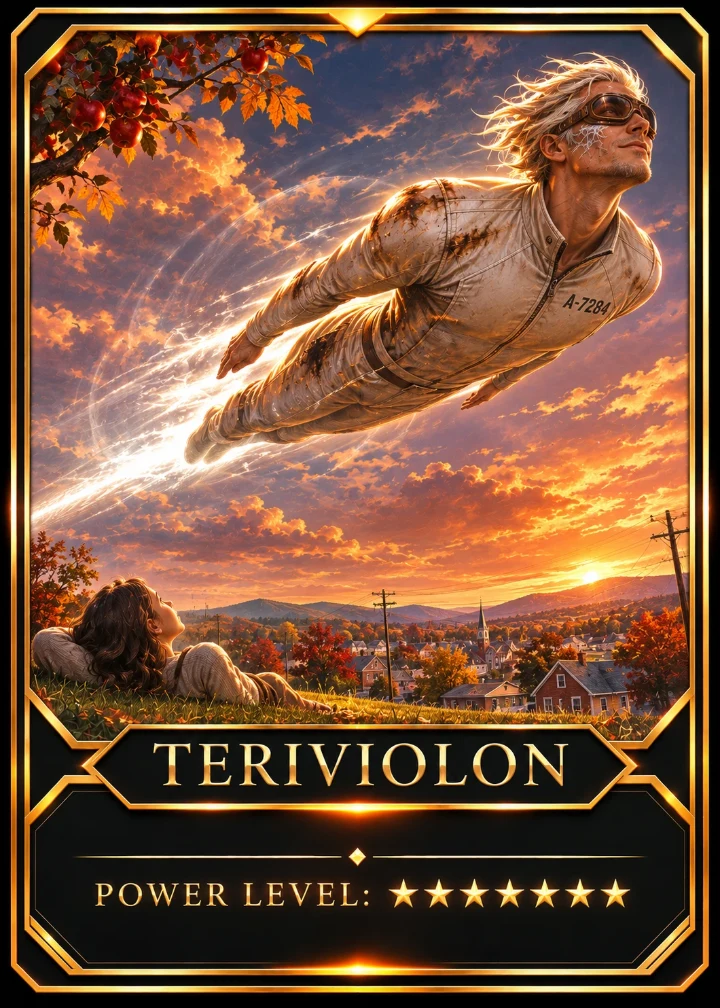
Teriviolon tore across it like a struck match. To anyone else he would have been nothing: a flicker at the corner of the eye, a cloud that shivered for no reason and then thought better of it. Alice saw him because she had her mother’s eyes, and her mother’s ears, and her mother’s everything else. A thread of white, east to west, gone before the sound of him arrived. Then the sound: a high, tearing hiss, like silk ripped very slowly from one end of the county to the other.
She lay on her back on the lawn with her arms flung out and her textbook face down on her stomach, and listened to it fade.
It was the last week of September, 1992. She had been thirteen for eleven days. The grass was still warm from the afternoon and smelled green, a deep wet green with a yellow edge where the sun had been at it, and somewhere under that the sweet brown rot of the first fallen apples by the fence. Over the back fence, Mr Fenton was mowing. Four streets over, a baby was refusing to go down for its nap. Alice could hear both of them, if she wanted to. Mostly she didn’t want to. Mostly she liked to lie in her own head, where it was quiet.
Next year she would start SuperSchool. Fourteen, and a trunk, and a uniform, and a school by the sea with a proper name, and people who would teach her how to be what she already was. For now there was PreSup, which meant ordinary lessons at double speed with a side order of Super conduct, and tests. So many tests.
“Do not use BHA,” she recited to the clouds, “beyond human abilities, near RP. Regular people.”
She understood why. She had been told why often enough. RP didn’t much like Supers. Not all of them. Some.
They’re frightened, that’s all, her mom would say. And her dad would open his mouth, the way he did, as if he had a whole other sentence waiting behind that one, and then close it again and go back to his crossword.
Supers had done a lot of good in the eighties. Everybody said so, in the voice people used for things that were over. Now most of them tried to keep their heads down, and it didn’t work, because Supers were always on the news no matter how hard they tried not to be. RP couldn’t stop looking at them. Alice didn’t blame them. She would have hated being regular.
Not that she knew much about it. She had only ever had one regular friend.
Simone. They had been eight. They had been climbing the beech at the bottom of Simone’s garden when a branch went with a crack like a rifle shot and both of them came down through the leaves together. Simone broke her arm. Alice broke her leg. And Simone lay in the grass with her own arm bent the wrong way and watched Alice’s shin bend the wrong way too, and then click, quite neatly, back into line, and knit itself whole under the skin, like a zip being done up from the inside.
Simone had screamed louder at that than at her own arm. Then there were parents, and phone calls, and voices through walls, and and, and and. That was the end of Simone.
After that her parents preferred her to stick with her own kind.
⁂
You might get nothing. That was the first thing they taught you in PreSup, before anything else, so you wouldn’t be disappointed. Not every child of Supers got powers. You might get one, from your mom or your dad. You might get one from each. And once in a while you got one from each and a third, all of your own, that nobody had seen coming. Nobody, as far as Alice knew, had ever got one of their own without first getting their parents’.
She had her mother’s senses. She had her father’s healing. She was still waiting on the third.
Her dad’s healing was quiet and practical and he used it the way other dads used a screwdriver: a cut thumb, a burn from the oven, Mom’s wrist the winter she slipped on the back steps. He would put his hand over the hurt and go still, and his heart would slow down the way a swimmer’s does before a long dive, and the hurt would simply stop being there. Alice’s healing didn’t ask her. It just happened, all the time, whether she wanted it to or not.
Her mother’s senses had been harder. It had taken years. In the beginning Alice had heard babies crying three streets away and a single cricket a mile off, sawing at the night until dawn. Her eyes would zoom in on a pigeon on an aerial at the end of the road and she would walk straight into the kitchen table. She couldn’t smell toast in front of her face because she could smell everything, a wall of it, every bin and every flower and every person in the street all at once. And touch had been the worst. She had felt the air move over her skin cell by cell, and every cell had shouted about it, until there were nights she thought she might go mad.
That was what nobody told you. The movies made it look easy: a flash of light, a bit of struggling, and then you knew exactly how to use it and put on a cape. It wasn’t like that. Roughly half of all Supers died because of what they could do. There was a word for that too.
She frowned at the sky, trying to dig it up.
Shit, she thought. Then: Shit, I thought a bad word. Then: Shit. Again.
She giggled. Her parents didn’t like her using it, and she never did, out loud. But in her head nobody told her yes or no or don’t think that, and in her head she said it as often as she liked. Her mother could hear a moth land on the far side of the house. She could hear Alice’s heart from the kitchen and tell you whether Alice was lying about her homework. Alice couldn’t do anything without her mom knowing, and her mom liked knowing. She liked it far too much.
So the inside of Alice’s head was hers. Her one private room. It had a lock on it, and she was the only one with a key.
“Where was I?” she asked the sky.
Corollary Adaptation.
Every textbook explained it with fire, because fire was the easiest. If you could make fire, you ought to have a Corollary Adaptation that made you immune to it. It didn’t count as a power, only as a CA, and it usually turned up a little while after the power did. Usually. When it didn’t, people made fire and burned themselves to ash in their own bedrooms. Or they had super speed without the reflexes to go with it, and ran through a brick wall at ninety miles an hour, and the wall won. Or they flew without the eyes to see where they were going. Or they came down on legs that couldn’t take it and snapped them like dry sticks.
Her own CA had arrived the year she learned to focus. Before that, headaches. Years of headaches, like a fist closing behind her eyes. Even now there were bad days. But she would not have given it up for anything in the world.
She was still hoping for the third. In thirteen years nothing had come. It could come any time, which was part of the problem, because some babies developed powers that… A girl at school had told her about one particular baby and one particular nursery, in a great deal of detail, and Alice had had nightmares for a week. It was what finally made her go and ask her parents whether it was true.
They had a deal, the three of them, as long as she could remember. They would never lie to her, as long as she never lied to them. So they told her: yes, it was true, sometimes. And that she shouldn’t worry about it. Too much.
Her third power, if it ever came, could be anything at all.
⁂
A long time ago, governments all over the world had tried to lock Supers up, and in some countries they had. In some countries they had done worse than lock them up. Here they had tried, and in the end it had come down to registration instead: you told the government when you were pregnant, you registered your powers, you sent your children to SuperSchool at fourteen. It mostly worked. Accidents aside.
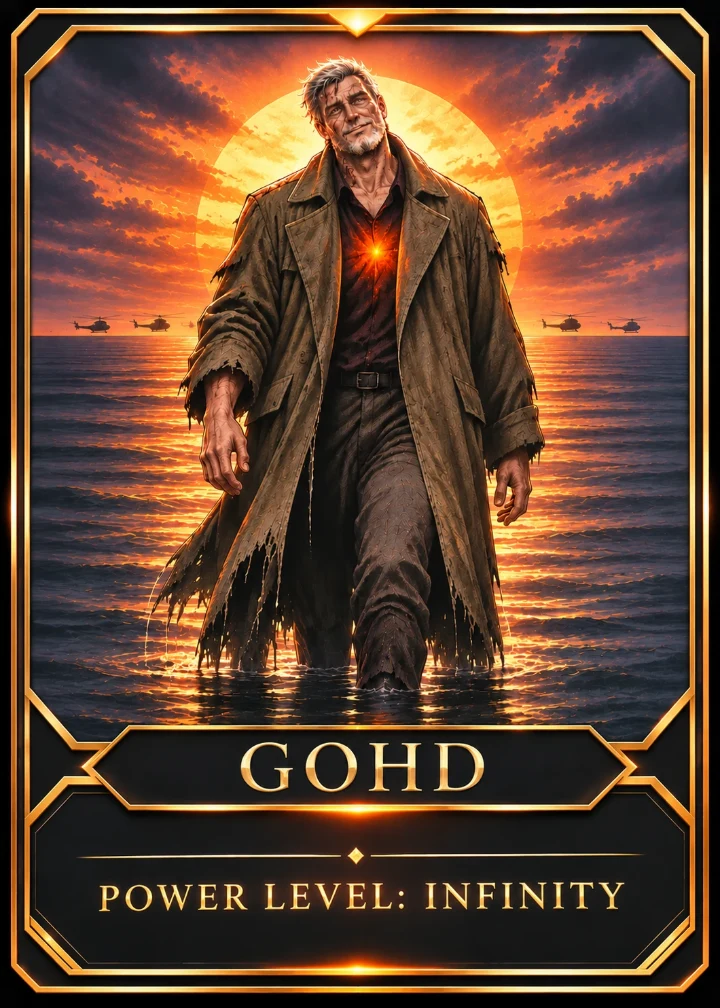
And then there was Gohd, on the far side of the world, who had taken three countries, and whose face was on the wall of every classroom in a grainy photograph with a pale spot of light where his heart should have been. Nobody liked to talk about Gohd. Her dad liked to talk about him even less than about RP.
You only have to look at Gohd, he would say, to know that something’s coming. And then he would talk about the AG, the Apocalypse Generation, and how three generations from now people would be born with ten powers apiece, and one of them would be a child who could turn oxygen into hydrogen and also rearrange atoms on a massive scale and also make things explode. That child could set the sky on fire. Mom would say Adam, in a certain voice, and he would stop, and smile, and say I know, I know, and go back to being an ordinary dad who made too much salad.
The more good Supers did, the more some people seemed to want to do bad. There was a name for that as well. It was definitely going to be in the test.
The textbook was on her stomach. She could have turned it over. She looked up at her bedroom window on the second floor instead, open, the curtain breathing in and out, and thought about getting up and going inside and up the stairs and into her room for the other book, the one with the answers in the back. Ten minutes, at least. It wouldn’t be. It felt like it.
Balance something.
“Balance of power,” she said. “Power balance. Balancing. It’s something to do with balancing. Shit.”
“I heard that!” her mother called, from Alice’s own bedroom window.
Alice winced at the sky. “Sorry, Mom! What’s it called? The reason there are villains?”
A sigh, floating down from the second floor. Alice could hear her mother’s heart, too, if she let herself: quick and steady, sixty-eight, a little faster than Dad’s. She could smell her, under the cut grass and the apples: honey and chalk dust, and under those a cold bright gold that was only ever her mother, the way the colour of a voice is only ever one person.
“AAE,” said Mom. “Ability Abled Entropy.”
Why did I think it was balance?
“Thanks, Mom!”
The window slid shut. It made no difference. Mom heard through windows.
Right. Power at one end made other people want power at the same end. Good and evil, pulling on each other like two ends of a rope. Mom always sighed at that bit, because Mom said there was no such thing as good and evil, only perspective, and Dad mostly agreed, and the two of them could argue about it for an entire Sunday lunch until the gravy went cold. Mom was a professor at the college. Dad was…
Alice frowned. An architect, she thought. Or he had been, last she remembered. He had degrees in all kinds of things, according to Mom, which meant he had tried all kinds of things and got bored of most of them. He never talked down to anybody. He cut cucumbers into half-moons with the concentration of a man defusing a bomb. She had never once thought of him as clever, and she suspected that was exactly how he liked it.
“Ugh,” she announced to the garden. “I’m tired of studying.”
“Too bad!” said her mother, from somewhere in the kitchen now. “You’ve got pages to go!”
Alice flopped back down.
Mom said the listening was for Alice’s own safety, and Alice said she hated it. That wasn’t quite true. Sometimes she muttered things on purpose, just to hear her mother shout back. It was a way of knowing someone was there. She would never have told her that.
She didn’t listen all the time herself. Not the way Mom did. Listening hard was like holding your breath with your whole brain; after ten minutes the world went grey at the edges. How her mother did it all day and still marked essays and made dinner and remembered which drawer the scissors were in, Alice had no idea.
I wonder where Teriviolon is now. I wonder if I could hear him land.
She closed her eyes.
It was a game she played sometimes, when she was bored. You picked one sound and you followed it, out past the near things, the mower and the baby and the kettle beginning in the kitchen, out past the edge of the town to where the world went thin. She found the hiss of him easily; she had heard it a hundred times. It was far now. East. Dropping.
There. He’s slowing. Slower. He’s going down. She frowned with the effort of it. I wonder where. If he lands I could hear what’s round him. Trees. A road. Somebody’s dog. Her head was beginning to hurt, the old fist behind the eyes. Come on. Land. Land so I can hear. Don’t let your head explode. Don’t let your head explode. Don’t…
A hand closed on her arm.
She came off the grass, flat on her back, an inch into the air. And the world came in.
All of it. All at once, as though somebody had kicked open every door in a house. Babies screaming in every street in the county. Cars, a thousand horns. Birds shrieking. The scrape of a million insect legs on a million leaves, the hum of a million wings, a roar with no edges and no bottom and no end, and every one of the sounds was inside her, in the bone of her skull, and her skin was screaming too, every cell of it, where the hand was.
Her eyes flew open. Her mother was bending over her, close, her hand on Alice’s bare arm, her face frightened, her mouth already making the shape of Alice’s name.
Alice stared up at her for one long second.
Then she gave the loudest scream of her life, and the world went black.