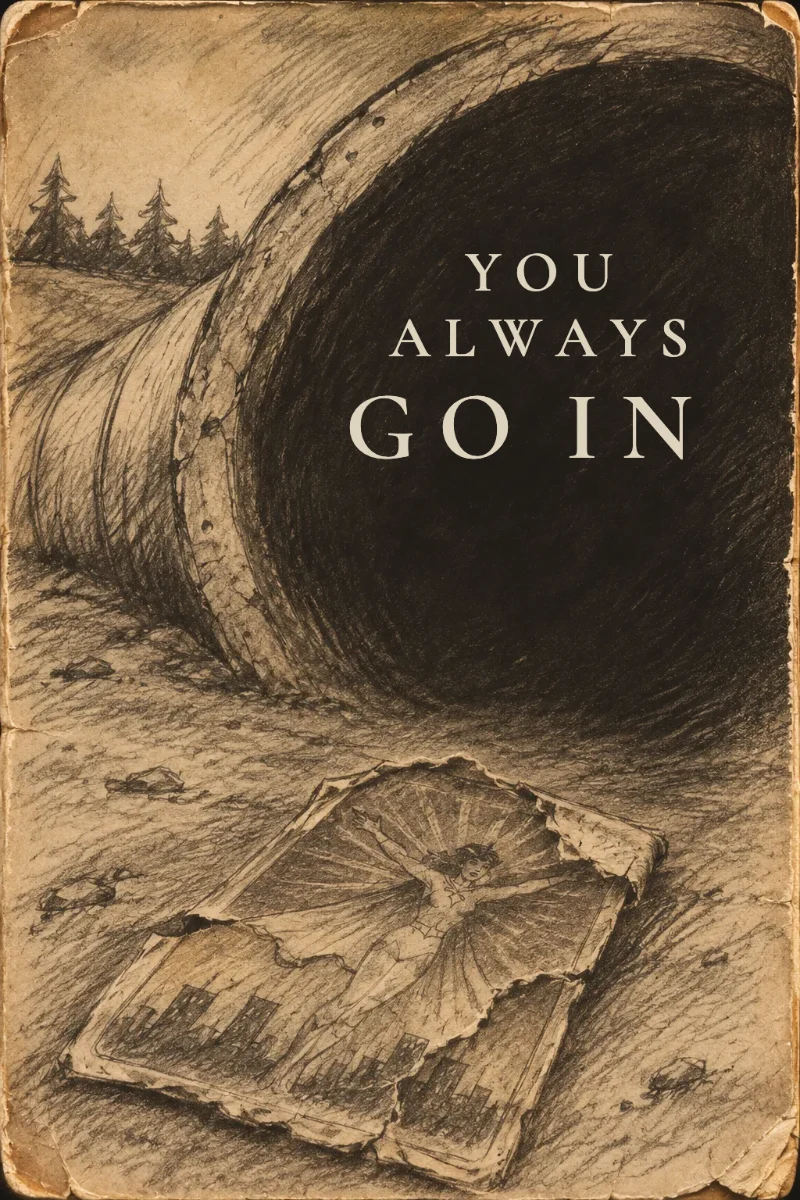
The Bridge
21 minutesMornings are the best time to look at people. They haven’t put their faces on yet.
No notes in this margin yet.
Soon you’ll be able to leave a note on any line, or stamp it:
chillscalled itre-read thisoh no
Joey Tarrant woke before the alarm, as he always did, in case something started without him.
The room was already warm. The window over his bed stood open on a sky the color of dishwater, and out in the maples the cicadas had started their one long note, the sound August makes when it is thinking. He lay still and let the house come to him. A pot lid rattled. A tap ran. His father’s chair scraped in the kitchen. Then the front door, then the car backing over the gravel, then nothing, and the house breathed out. His father left every morning like a man walking out of church mid-sermon, loudly and without looking back.
Joey was sixteen. He told people about the girls he’d kissed at camp, a different one every summer, and he watched their faces to see if they believed it. He had counted the true ones on his fingers the night before and hadn’t needed a single finger. The lie came out smooth because he had practiced it in the bathroom mirror, mouth shaping every word slowly. The hard ones got the most practice, over and over, Can I c-c-come, w-w-wait for me, please, until the words slid out whole. Certain sounds still caught in him like a sleeve on a nail. Nobody had ever asked him to practice. He just couldn’t stand the look on people’s faces while they waited.
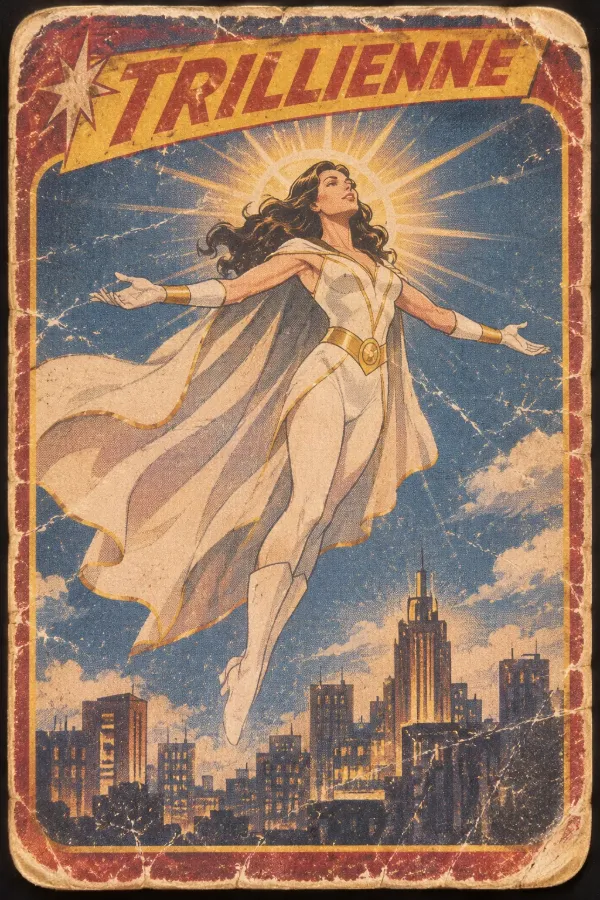
On the dresser, between a stack of comics and a jar of Ora Cola bottle caps, sat his Trilienne card, the foil peeling at the corners: a superhero, a woman in white with her arms open, hovering over a city as if she were its savior. All summer he had bought cards at the Corner Mart, eleven cents a pack, and most of them had gone missing the way things did, swapped or swiped or simply gone. Not her. Boys had offered comics, candy, a whole shoebox of doubles, and once even a Gohd card, the rarest in the set. The answer was always no, though he couldn’t have said why. Most days she rode in his shirt pocket, against his heart. Only the handiest pocket, he told himself. Joey had grown good at lying over the years, mostly to himself, which may be why he was still waiting for a woman who came in a wax pack.
“You’re not going out in that heat without eating,” his mother called.
She was standing at the stove when he came in, her back to him, her apron strings tied in the bow she always tied, a little crooked. Without looking, she held out a plate: toast, an egg, a slice of peach already going brown at the edges. With her other hand she stirred something in a pot, though it was not even seven yet. She was humming. It had no words, or the words kept slipping out of reach, and he thought it was the most beautiful thing he had ever heard. He wondered why he had never heard it before.
“What’s that song, Mom?”
“Mm?”
“The one you’re humming.”
“Am I?” She stirred without looking away. “Eat, honey. He will be waiting.”
He ate quickly, because Tommy didn’t wait happily. On the way out he stopped behind her and hugged her, which he hadn’t done since he was ten. It felt right. More than right: it felt needed. She smelled of onions and soap and something under both, cold and mineral, like the first breath out of a cellar.
“See you later, Mom,” he said.
“Before the lights.”
“Before the lights, Mom.”
She didn’t turn around. She hummed.
⁂
Across town, in a kitchen that smelled of last night’s whiskey, Tommy Richardson stood at the sink with his shirt off and ran cold water over his wrists. The house was quiet in the way it got after a bad night, when everyone was being very careful with the floorboards. His father’s boots stood by the door, laced, toes out. Tommy read them the way other people read weather: boots by the door meant sleeping, no boots meant the old man was out and the house could breathe, boots on the stairs meant stay in the kitchen. This morning they stood empty and polite. Upstairs the bed creaked once and went still, and Tommy stood without moving until the house decided to let the sound go.
He did not look at his ribs. He looked at the window over the sink instead, at the long crack he had taped back together in March, neat as a surgeon, because somebody in this house had to fix things and it was never going to be anyone else. Two slices of toast sat on the counter, made before he washed. He had buttered them the way Mack liked, right out to the edges, and cut them on the diagonal. The smell of toast tried to cut through the whiskey and lost.
The sky through the glass was a flat, sullen gray, hung low, with no sun in it anywhere. It was going to be one of those days with a lid on it, hot and low and waiting.
Mack came in on his toes, the way he always did, as if the floor were just waiting for a chance to get him into trouble. He had been at the Richardsons’ since he was nine, brought by someone and left by someone, and nobody had thought to ask by whom. Seven years on, he still moved like a guest. He lifted a slice of toast off the counter, sat at the table, and began folding a sheet of photocopied paper into quarters, careful not to get butter on the edges, which were already gray from handling. He was small for sixteen and so quiet that teachers kept looking at him without knowing why. He ate his toast without a word, which told Tommy nothing. When Mack was fine he said nothing. When he wasn’t, he said nothing louder.
Tommy had once knocked a boy’s tooth through the boy’s own lip for calling Mack the charity case. He never thought about why. “My little brother,” he told people, in the voice he kept for dares, and then he waited, and nobody ever took the dare.
Tommy slid the second slice across the table and ruffled Mack’s hair, roughly, the way big brothers do, and Mack allowed it. Mack tucked the folded pages into his pocket without looking at them, or at Tommy. Tommy eased into his chair with a small flinch and did not look at the pocket either. In a house like this you learned to leave some things alone. Digging was for graves.
Tommy pulled his shirt on over the ribs, wincing, then grinning it off, the way other people button a coat. On his way to the door he passed another cracked window and touched the tape with two fingers, checking that it was still holding.
“Bridge,” Tommy whispered.
“Bridge,” said Mack.
They went out the back, as they always did. The back door was their friend. The front door was a snitch.
⁂
Nate Radcliffe, Rad to his friends, stood at the window with his cereal going soft. He had not eaten properly in two days, not since the county archive, and the bowl was less breakfast than an alibi for looking normal. His father’s cruiser was already gone from the drive. It always was by now. Jonah Radcliffe was a good sheriff in a town where nothing happened, and every morning he went out to look at that nothing like a man checking a lock twice.
On the table was a note in his father’s square capitals: BACK LATE. LOCK THE BACK DOOR. Nothing less, nothing more. Beside it lay a page of Rad’s own handwriting, folded small. He turned it face down without reading it. He knew what it said. He kept lists, the way other boys kept scores: the things he knew, the things he suspected, the things he was afraid of, and lately the three columns had begun to run into one another. Some nights the answers seemed to come together, but they were gone by morning. Other nights he wondered whether having a cop for a father was such a good thing.
Upstairs in his room, Andy was already awake, a scruffy white cockatoo with a lemon crest, working at the latch of his cage with the patience of a burglar. The bird had been Rad’s since he was twelve. He rode a shoulder through homework and sang Rad-ical, Rad-ical in a voice stolen from the boy’s own, and every morning Rad whistled the same three notes back, because somebody had to. Since the spring he caught himself watching the bird for too long, the way you watch something you dread losing.
His mother had struggled to sleep most of this summer. At night he heard her on the stairs, going down, like a ghost who had forgotten to float. He had seen her standing a long time in the dark kitchen, then coming back up as if she didn’t know she’d been gone. He had never asked. Once he had stood on the bottom stair with his hand on the rail, a silent witness, and in the morning she had made pancakes, humming, as if the night had never happened.
“Take a hat,” his mother said, from the sink, her hands in the water. “It’s going to be a scorcher.”
“It’s always a scorcher.”
“Then take it twice.”
She dried her hands on the towel and came to fix his collar, which did not need fixing. She held on a second longer than she needed to, staring at him as though trying to memorize his face.
“Be home for dinner.”
“Pizza at ours, maybe?” he asked. “If they want.”
“Later, then,” she said, and smiled, and said it again as if testing its weight. “Later.”
He took the hat and stuffed it in his back pocket as he walked away. At the door he looked back at her, standing at the sink again, the dish towel over her shoulder, both hands on the edge as though she were praying or exhausted. He couldn’t tell which. Something was off; he could feel it, the way you feel a stair that isn’t there. But his friends were waiting, and at sixteen friends win. It was adult stuff, he told himself, and he went. As far as he knew it was just another day.
He counted the fence posts to the corner, as he always did, because counting kept the other things in their boxes.
He turned left onto Cutler Street, toward the bridge.
Four boys woke in three kitchens, and I looked inside all of them, because that is what I do first. Looking in is easy. It is also, I have found, mostly disappointing. Two of them were hiding something. One was afraid of missing out. The other was afraid of being found out. Both kept the fear in a box and called it a personality. The third seemed to be only a boy.
I kept the fourth. I couldn’t tell you why. I have watched ants do worse with less.
From here on I will tell you only what he thinks. The others you’ll have to guess at, the way he does. It’s more fun that way. For me.
* * *
Springwell, 14 August 1979
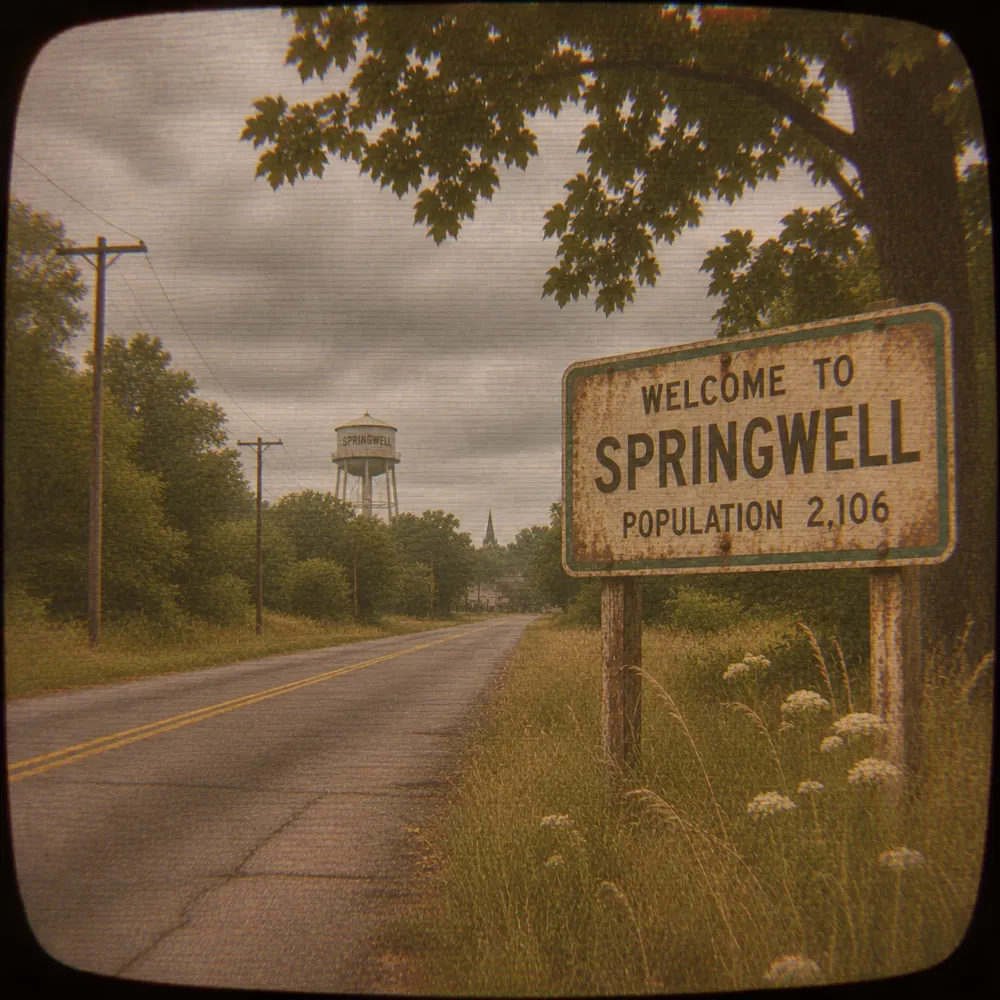
Springwell is the sort of town that puts its founding year on the water tower, and what it has to say for itself has been repeated a thousand times, like a grandfather reliving his heyday. The sign at the edge of town says 2,106 people, and has said so for as long as anyone can remember, which is not as long as you’d think. It began as a mining town, though no one can tell you now what it mined. The mine is gone, and so is the reason, and the town has carried on regardless, little by little, like a clock ticking in an empty house. Maples. A river called the Warra that no one has thought to be proud of. A main street with two churches, one diner, a grocery store, a pharmacy, a hardware store that opens when it feels like it, and a fuel station where a sitting president once pulled over to use the restroom. There is a plaque. It is the town’s second-proudest possession, after the water tower.
Springwell has had exactly four famous people rest their heads here, either for a night or longer. One of them was born here. The other three broke down on the way through. Miss Harson, who cuts hair and does the barbering besides, has by her own count trimmed two hundred and forty thousand heads, and knows which ones came in worried. The town remembers odd things and forgets important ones, it seems. The people are polite, and they wave from their porches. Sometimes they wave regardless of what they see, as though staring straight through every situation. Mr. Fletcher at the pharmacy knows the name of every one of the town’s 2,106 people and will remind you of it, directly, usually while handing you something for your cough. He insists that it’s 2,032 now.
Today the heat is the kind that makes people honest or stupid, usually both, which leads us neatly into the lives of five kids, though sixteen-year-olds would never admit to the word.
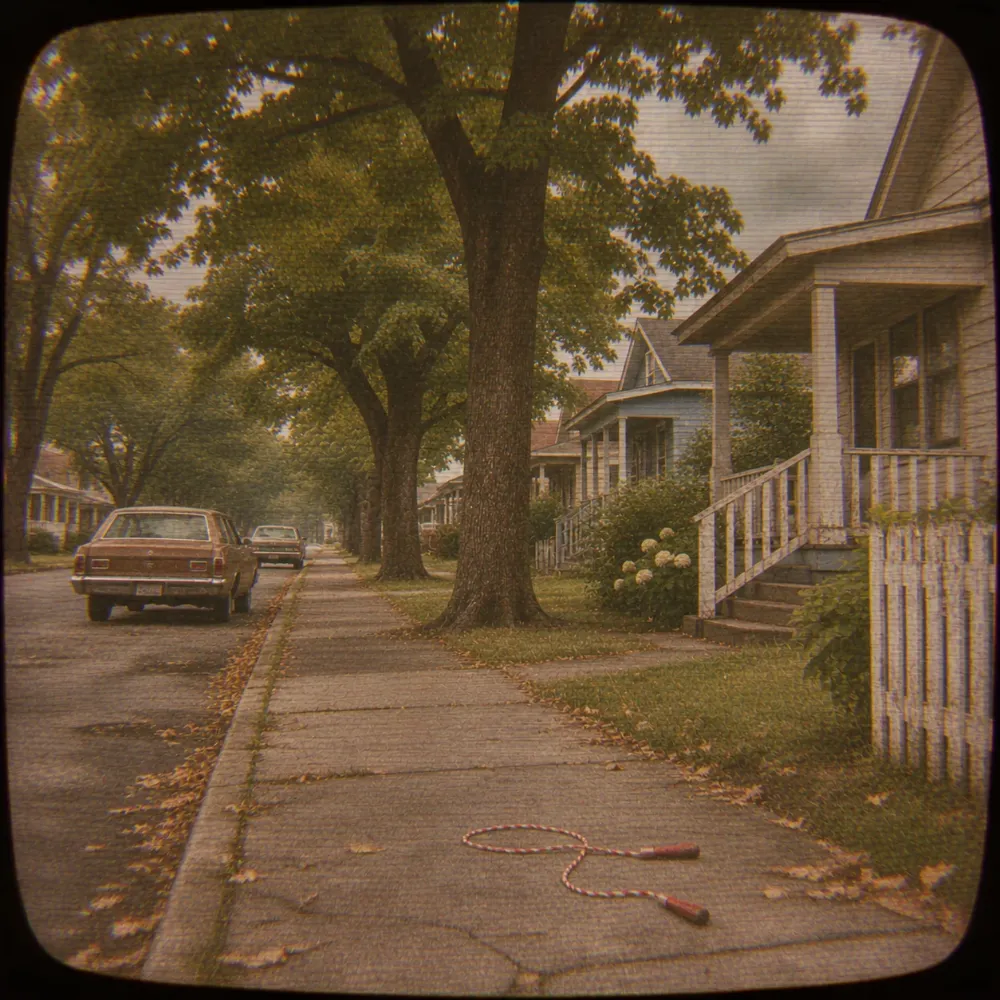
The little girls on Cutler Street were jumping rope when Rad passed them, and they stopped the moment they saw him. They hadn’t stopped for him, not exactly. They stood and stared down the street, nine or ten of them, braids and scabbed knees, and the rope hung slack between two of them like something that had died mid-swing. Every face had turned the way he was heading, toward the edge of town. One of them had been mid-line. Her mouth was still open on a shape that might have been home. Then the rope started up again, and the chant went on without anyone seeming to decide it should.
He walked faster. It was the fourteenth of August and so hot that even the shade felt used. He was sweating through his shirt, and still the back of his neck went cold.
One day, one day, it’ll bring you home.
He had never once heard a grown-up teach the rhyme to a child. Nobody could tell you where it came from. It was simply part of the town, the way the river was.
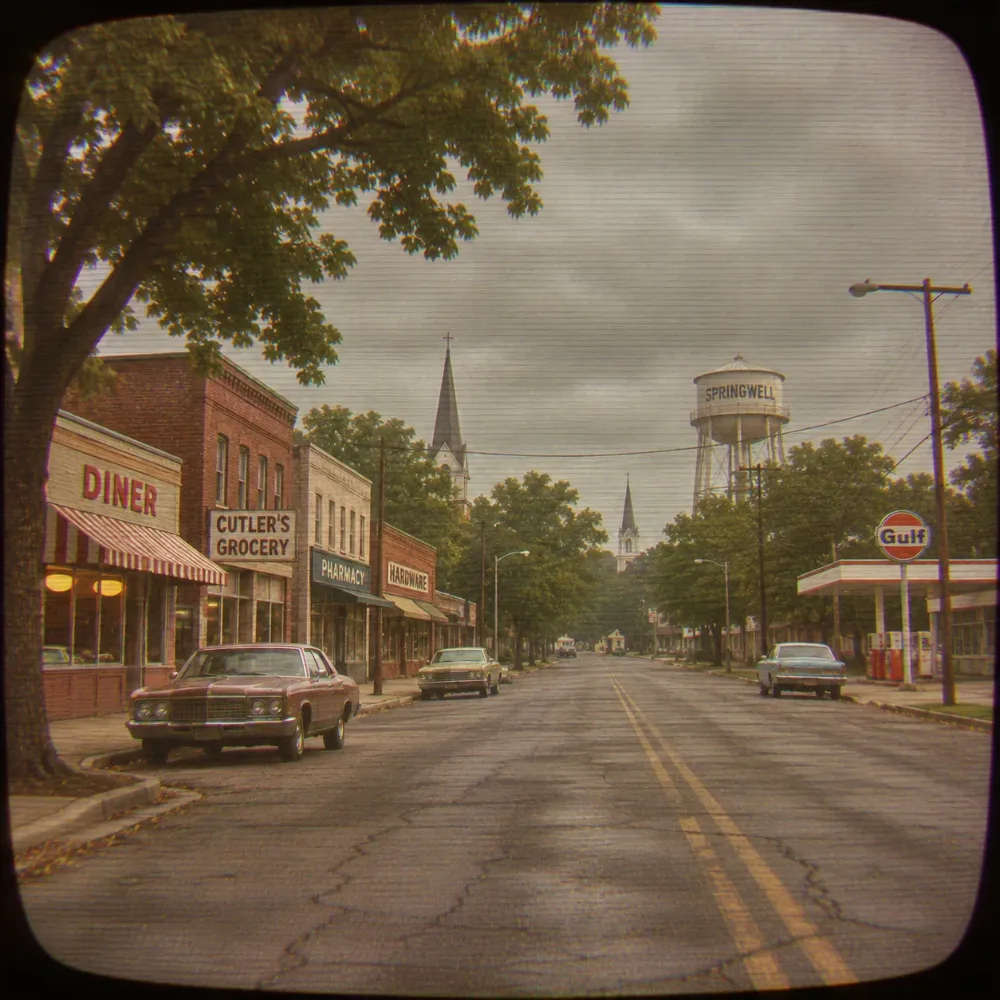
Cutler Street was the spine of Springwell. It ran straight through the middle of town, past the shops and the diner and the two churches, then past the last of the houses, where the sidewalk gave up and the asphalt crumbled into gravel. By then it was Mill Road, though nobody bothered to say so. It was a long walk, and the farther he went the emptier it got. The trees crowded in. The road dipped between sumac and cottonwood, the air turned cooler, and the ground fell away to the Warra, low and brown and slow, and the bridge: a skeleton of orange girders no one had crossed in a decade, well, almost no one. Once it had carried the miners out to the mine and home again at night. The mine was shut now, and past the bridge there was only the old mine road, and whatever it led to. The county had put up a sign saying CLOSED, and the sign had rusted half away. This made it theirs. You could lie on your back on the boards with the heat coming up through your spine and the whole town too far off to bother you. Almost nobody told you what to do on the bridge. Almost nobody told you anything. The river below smelled of warm mud and old pennies, and somewhere in the girders a bolt ticked as the heat worked on it. The clouds sat low and swollen over the town and refused to break. All of them were waiting for rain.
The boys were already there: Joey, Mack, Tommy. They gave him the kind of vague hello you give people you’ve known so long that hello has become an afterthought. Each of them was busy with something and nothing at the same time. Tommy’s shirt was balled on the planks, his body hooked over the railing like a gutted fish. Rad’s eyes went where they always went. Yellow bruises ran across Tommy’s ribs, a ladder of them, the shape a belt buckle leaves when the swing is practiced and meant. Tommy caught him looking and rolled his shoulders so that the muscles slid under the marks, and grinned.
“Like what you see, Rad-Cliff?”
“Not even a little.”
“Liar.”
That was how Tommy said we don’t talk about it. Rad had known Tommy Richardson since they were seven, and in nine years he’d never once heard him say a word about his father, good or bad. Rad had only seen the evidence of the man, rotating through its colors, purple to yellow to brown, like weather. Now that he thought about it, he had never once seen the man himself. In a town this small, that should have been impossible.
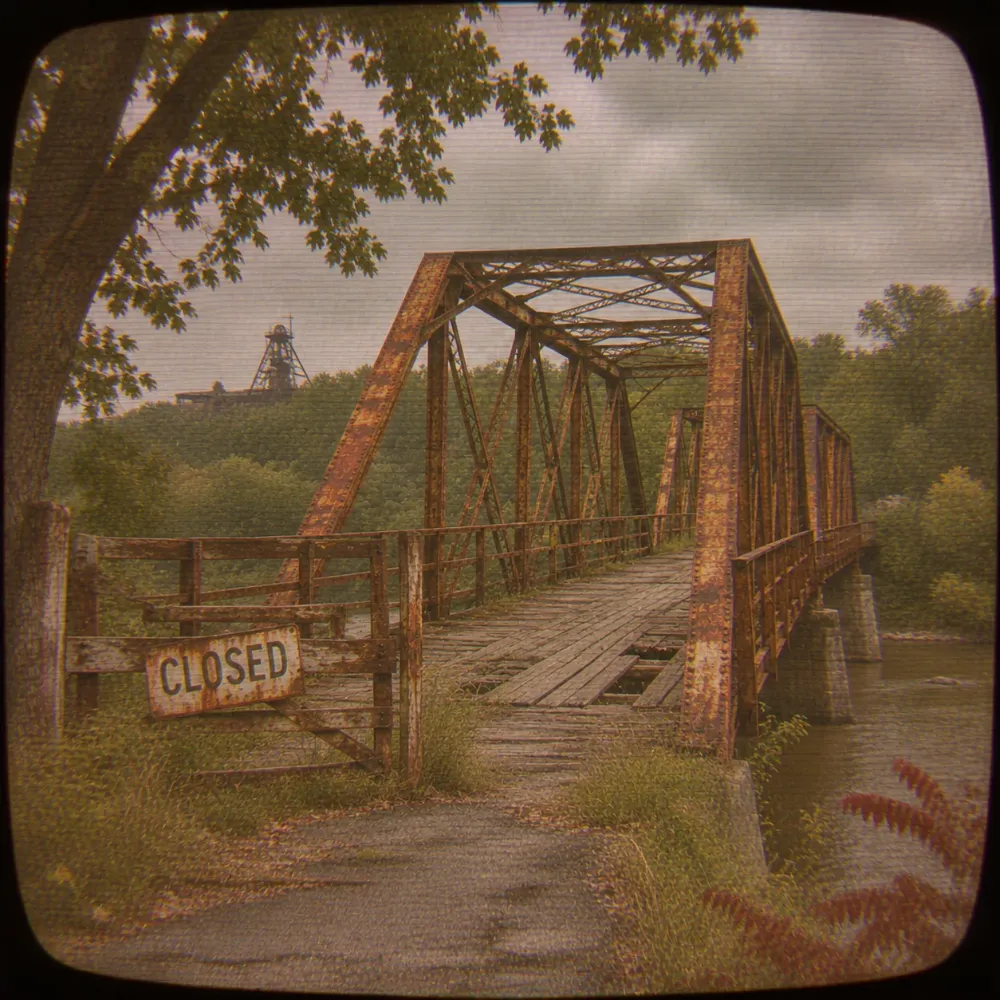
Joey sat cross-legged at the middle of the bridge, flicking stones into the water. The Trilienne card stuck out of his shirt pocket, foil peeling, the woman in white hovering over her city. He flicked the stones the way he did everything, slightly too early, as if he were afraid of being caught holding on. Mack stood a little apart, leaning on the rail, his back to the town, gray-eyed, watching the water as if it owed him money. Nobody had ever used his first name; he’d been Mack from the day he arrived. He had a folded wad of photocopied pages in his back pocket that he kept touching when he thought no one was looking.
Nobody wanted to move. Joey lay back and covered his eyes. Tommy had found a few bolts and was flicking them at the river, one lazy shot at a time. Without a word he toed his balled-up shirt across the planks to shade Joey’s face, then went back to flicking as though he hadn’t.
“We could go to the quarry,” Joey said from under his arm eventually.
“Too hot to walk,” Tommy groaned.
“Pool?” Joey tried.
“Closed. Somebody threw up in the deep end,” Mack offered.
“That’s the most excitement the pool’s had all summer,” Joey said.
Rad laughed before he could stop himself. For a second it was just an ordinary August.
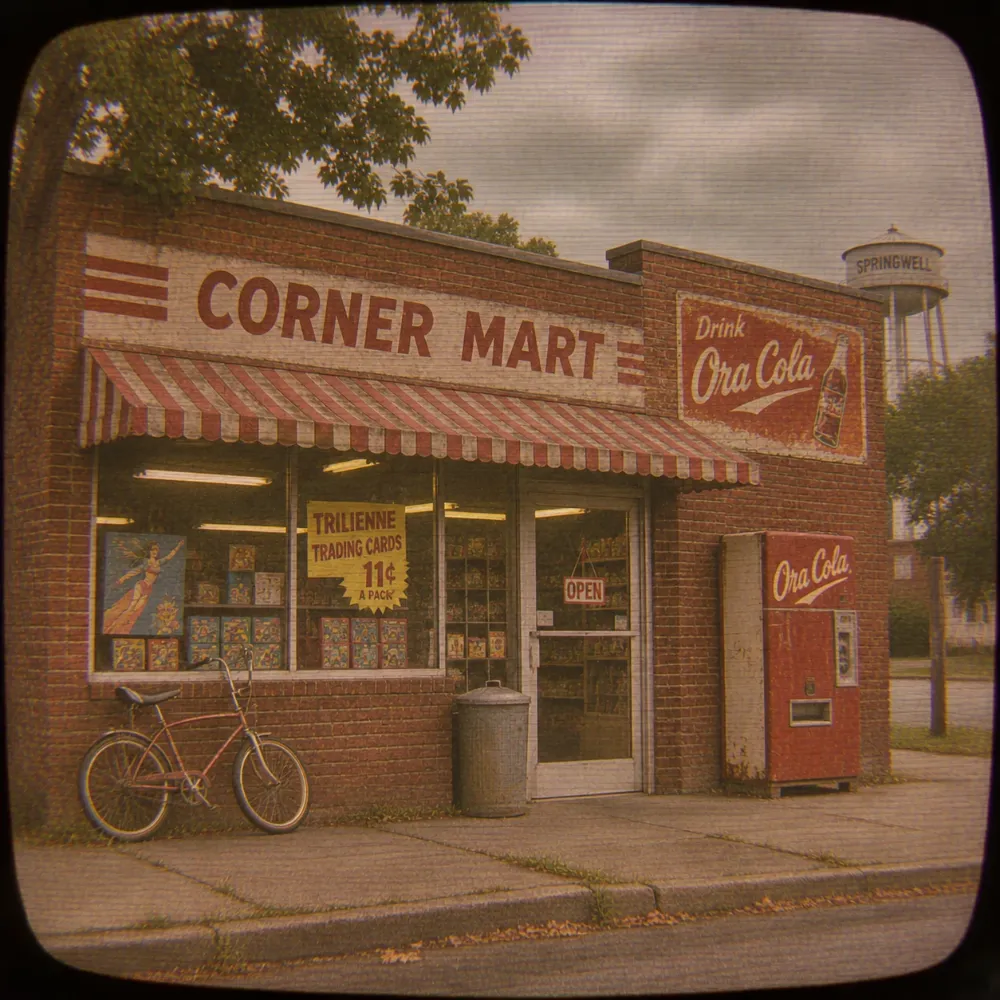
“Corner Mart, then. Popsicles,” Joey tried again.
“They ran out Monday. New stock only comes next week,” Rad said, lowering himself onto the planks.
“We were at the quarry on Tuesday,” Mack said, without looking at any of them, and took a folded piece of paper from his back pocket. He seemed lost in thought.
So they did nothing, which was what you got when you mixed hot weather with boredom: a lot of boys with nowhere to put it.
“You know,” Mack said, folding the paper smaller, “I’ve been reading about something. I think we should check it out.” He looked from one of them to the next. “Aren’t we the only people who haven’t?”
“Haven’t what?” said Joey, lifting his arm.
The hair rose along the back of Rad’s neck. He knew. Mack had been circling it all summer, a word here, a question there, and now here it was. His mouth went dry, and time slowed, the way it does at the top of a fall. Then Mack said the most dreadful word in the English language.
“Tunnel?” Mack asked. He asked it the way you’d ask about the weather. A flake of rust broke away from the rail under his elbow and drifted down toward the river, turning over and over, and nobody heard it land.
Rad’s stomach dropped.
Tommy’s head came up.
For a moment even the cicadas seemed to hold off, as though the whole day were leaning in to listen. Under Rad’s shoes the old girders ticked and settled, and a long way below, in the brown shallows, something broke the surface and went under again.
“Tunnel,” Tommy said, as though testing the sweetness of the word. He looked up at the sky. Rad stared at him a good long while, unable to swallow the stone in his throat. Somewhere in a primitive part of his brain he was begging without words, begging for an outcome he knew would not come.
Tommy grinned. It wasn’t a bad grin, as grins went. It was wide and boyish and it carried the whole summer in it. But it was the last grin Rad wanted to see just then.
“What’s the worst that can happen?” he added, looking from face to face, his eyes suddenly full of menace.
For the briefest of moments Rad felt that something here was untrue, the way a fever dream hands you ridiculous scenarios that knot into a maze. Then it was gone.
“What?” said Joey, looking at Rad with large eyes.
“Yeah, let’s go to the fucking tunnel.”
Joey jumped up so fast he nearly lost his footing, bashing against the rusted girder, which shed another flake of itself to fall, unheard, into the water below.
“Wh-” Joey started.
“We go to the tunnel, and then we…” Tommy trailed off, working his jaw as if the idea needed chewing. “We…”
Rad and Joey looked at each other. Joey’s face had gone the gray of old putty.
“I’m not sure that’s a good idea, Tommy,” Rad said.
It came out thin. But it came out. Rad listened to his own voice on the hot air and felt as if he had stepped off a curb that wasn’t there. In nine years he had refused Tommy only a handful of times and had paid for it in pain. Now something deep in him had dug in its heels, and he couldn’t have said why. The tunnel… He’d seen it once, from so far off it was only a dark smudge between the trunks.
But he’d read about it. That was the trouble.
Tommy’s fist hit his shoulder, hard.
“Too chicken, Rad-Cliff?”
The blow spun him half around. For a second there was nothing, just the bright surprise of it, and then the pain arrived, hot and deep, as if a coin had been pressed into the bone. He bit down on his lip. Crying would only make it worse. He had learned that the way you learn a language: by being thrown into it.
Why was he friends with him? He asked it every few months and the answer never changed. Because Tommy didn’t know how to hear no, and everyone around him had learned to stop saying it. And because, in the nine years since they’d met, Tommy had also hauled him out of the river twice, split a lip for him in the schoolyard, and once given him, wordless, the last cigarette in the pack. Because the only thing worse than being Tommy’s friend was not being. Tommy was two years older, as tall as Rad’s father, and carried himself like a boy who’d decided early that the world would have to go through him, and that he wouldn’t make it easy.
“Maybe Mack and I will go alone,” Tommy said. “Since you’ve got no balls.” He swung toward Joey. “Or have Joey’s finally dropped?”
“I-I-I…”
“I-I-I. Told you,” Tommy sneered. “Run home, then. Play with your little toys.”
Rad wished running home were that easy. He would have scrubbed every floor in the house for a pass off this bridge. Behind his eyes, a picture he did not want slid into focus: a brown page, a pencil sketch, a circle of men standing around a hole in the ground. He’d found it in the county archive, in a box nobody had opened since before his father was born. He had spent three hours there and come out unable to eat. He had read one page twice, to be sure it said what it said.
“Some things are just stupid,” he said.
He turned his back on them and fixed his eyes on the river. Behind him Mack said nothing, which was how Rad knew he’d been heard. The Warra was low this time of year, a brown wire threading between mudbanks, a long way down. He caught himself measuring the drop, the way you eye a door when a room has gone wrong. Anything, anything at all, to be somewhere else right now.
No. Jumping would be as stupid as the tunnel.
Refusing would cost him. It would be small at first: Tommy would yell after him and call him names. Sticks and stones. But then they’d go anyway, and if everything turned out fine, the next few months would slowly rot into a hell of their own. He’d hear from them less, Joey included, because at the heart of it Joey was a coward, and Rad hated that he knew it. Tommy would make him pick a side. Little by little Rad would lose them, and everyone else who might have thought about talking to him would feel Tommy’s shadow. Tommy could be hard, but he was also patient and smart, and in the end he always got what he wanted, anywhere but at home. Somewhere in Rad’s head it all made a kind of sense that a kid couldn’t have explained.
Saying no to Tommy would have hell to pay, but the tunnel was the worse idea. If his friends had all happily decided to set themselves on fire, would he really want to join them? No. That was it, then. He had decided. This was his stand.
Tommy would take something. That was what happened. The last time Rad had said no, this spring, over some smaller stupidity he could no longer even recall, he’d come out the next morning to find his bicycle gone. It turned up three days later at the bottom of the creek, front wheel folded like a taco, a scrap of paper taped to the handlebars. The handwriting was angry and childish. Nobody had needed to sign it. Rad had stood on the bank with the dripping frame in his hands, and the worst part was that Tommy never mentioned it. It stayed unspoken, a punishment nobody named, and it did its work anyway. Rad told his folks he’d ridden it off a hill by accident. The boys had seen the frame. Tommy looked at it for a long moment and gave one slow nod, the kind that could have meant anything. Joey found something interesting in the river. Mack said nothing, and Rad took it for tact. What else could he do? He had no proof, only certainty, and besides, whatever else could be said about Tommy, he kept the bullies in check. Tommy bullied the bullies. Without Tommy, life would be worse. Rad had seen what school looked like on the days Tommy stayed home.
He kept his eyes on the water and waited.
“Come on,” said Mack. “How bad can it be?” He said it lightly, rubbing his chin with two slow fingers, and then his hand drifted to the pocket with the paper in it.
“I-I’ll go,” Joey said. Rad looked at him, trying to read what had just happened, trying to see what had so suddenly changed his mind. His no was still in his mouth, but nobody was asking for it anymore.
“There you go, chicken shit,” Tommy said.
Rad turned, and his stomach dropped. The no that nobody had asked for was suddenly up for debate as three pairs of eyes stared at him, waiting. His mouth was dry. Something low in him tightened and went still, the way a rabbit does when a shadow crosses it.
Tommy grinned and looked over at Joey.
“Look who grew some balls.” Tommy raised his hand and Joey ducked on instinct; the flinch hung in the air between them for half a second. Something passed over Tommy’s face, too quick to be named. Then it was gone. “High five, asshole.” Joey gave it, reluctantly, and Tommy made it so loud that it rang off the girders.
“Chicken shit’s coming with me. How about you, pigeon shit?” He turned to Rad.
Joey was rubbing his hand against his shirt, his eyes wet and his jaw set. Tommy’s high fives usually threatened wrists. This one had meant it. What was Tommy doing? What were any of them doing?
Something steadier flowed through Rad, a determination that was no longer stuck and seemed to have a life of its own. He opened his mouth.
“N—”
“What’s the deal with the tunnel?” said a new voice.